The Power Plant That Creates Its Own Fuel
Picture this: It's a hot summer evening in 2050. Your AC is running full blast. Your EV is charging in the garage. Every house on your street is lit up. And yet—there's no power cut. No load shedding. No worry about coal running out or fuel prices shooting up.
How? Because India cracked a code that most countries are still struggling with.
On April 6, 2026, something historic happened in Kalpakkam, Tamil Nadu. India's Prototype Fast Breeder Reactor achieved what scientists call "first criticality." In simple words? It started working. And this isn't just another power plant. This reactor does something wild—it creates more fuel than it burns.
Let me explain.

What India Just Achieved And Why It's a Big Deal
India just turned on a nuclear reactor that doesn't just produce electricity—it actually breeds (creates) new fuel while running.
Think about it: Most power plants burn coal or gas, and once it's gone, it's gone. You need more. Always. But this reactor? It uses fuel, generates power, and at the same time, creates more fuel for the future.
It's like planting one seed and getting back ten seeds along with the harvest. That's the breakthrough.
How Nuclear Energy Actually Works
Step 1: Inside an Atom (The Tiny Universe)
Everything around you—your phone, your chair, even you—is made of atoms. They're incredibly tiny. Inside each atom is a nucleus (the core), which contains enormous energy locked inside.
Here's the thing: If you can split that nucleus, you release a huge amount of energy. That process is called nuclear fission.
Simple analogy: Imagine a tightly wound spring inside a locked box. When you break the box open, the spring releases all its stored energy at once. That's fission.

Step 2: Chain Reaction (The Domino Effect)
When one atom splits, it releases not just energy but also tiny particles called neutrons. These neutrons hit other nearby atoms, causing them to split too. This triggers more splits. And more. And more.
That's a chain reaction—like dominoes falling one after another.
In a nuclear reactor, this chain reaction is carefully controlled. It's not an explosion (like a bomb)—it's a steady, managed process that produces heat continuously.
Honestly, think of it this way: A fireplace has a controlled fire. A bomb is an uncontrolled explosion. Nuclear reactors are fireplaces, not bombs.
Step 3: Heat → Steam → Electricity (The Power Loop)
The heat from fission is intense—hot enough to boil water instantly.
Here's the simple flow:
Nuclear fuel splits → Releases heat
Heat boils water → Creates steam
Steam spins a turbine → Generates electricity
It's the same principle as a coal plant or gas plant, except the heat source is nuclear fission instead of burning fuel. Way more efficient. Way cleaner. No smoke. No CO₂.
Step 4: The Fuel Problem (Why Normal Reactors Have Limits)
Most nuclear reactors use Uranium-235 as fuel. But here's the catch—Uranium-235 is rare. It makes up less than 1% of natural uranium.
The rest? It's mostly Uranium-238, which can't directly produce energy in regular reactors. It just sits there, unused.
So you mine tons of uranium, use only a tiny fraction, and the rest goes to waste. Not very efficient, right?
That's where India's 3-stage program comes in.
Step 5: The Breeding Concept (Making Fuel While You Burn It)
Now here's where it gets cool.
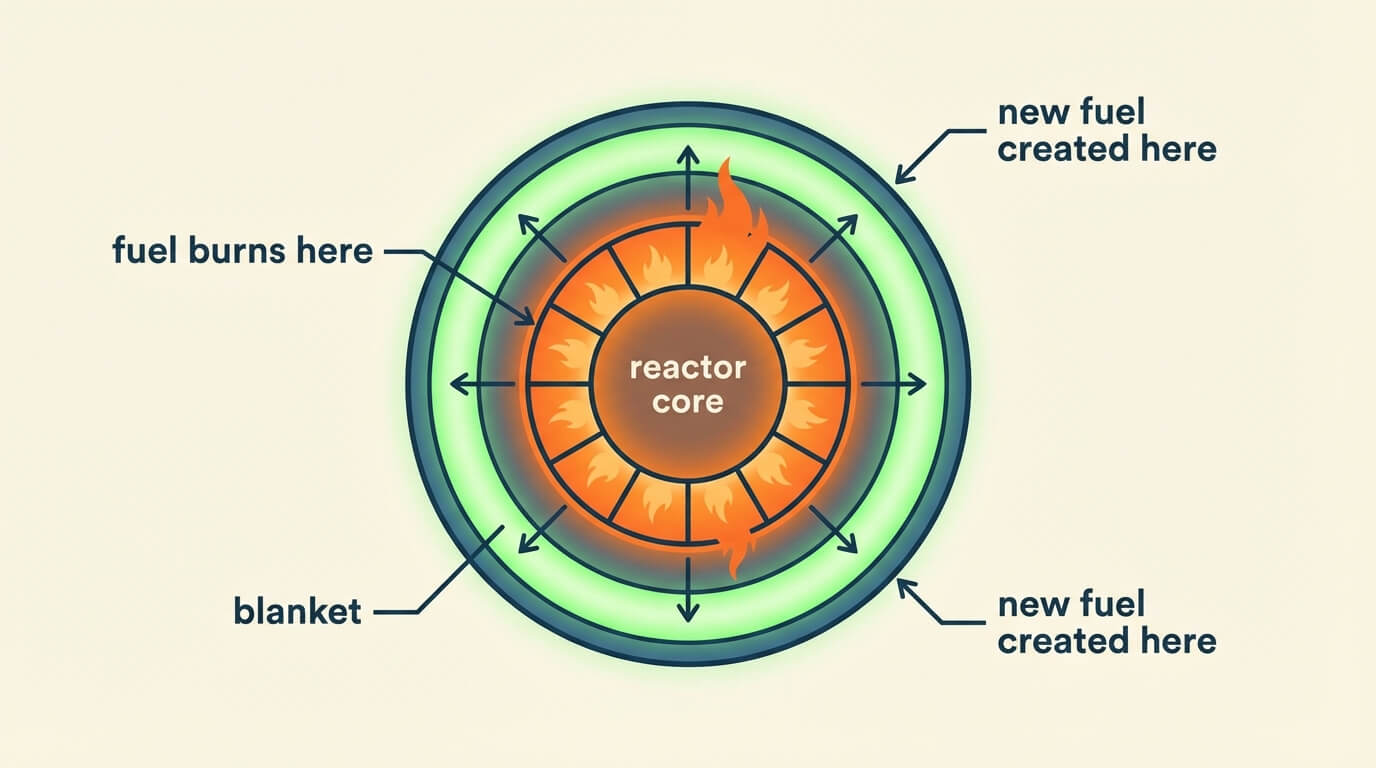
A Fast Breeder Reactor uses a different kind of fuel—a mix of uranium and plutonium (called MOX fuel). And it runs on "fast" neutrons (neutrons that move super fast, unlike the slow ones in regular reactors).
Here's what happens:
The reactor burns plutonium to produce energy
While burning, fast neutrons hit the surrounding Uranium-238
This converts Uranium-238 into Plutonium-239 (new fuel!)
So you're creating fuel while using fuel
It's like a self-recharging battery. You use energy, and the battery charges itself at the same time.
Over time, this reactor produces more fuel than it started with. That's "breeding."

India's 3-Stage Nuclear Journey (The Master Plan)
India doesn't have much Uranium-235. But you know what India has in abundance? Thorium—about 25% of the world's reserves.
Thorium can't be used directly as fuel, though. It needs to be converted first. So Indian scientists designed a brilliant 3-stage plan:
Stage 1: Uranium Reactors (The Foundation)
India started with regular reactors using natural uranium. These are called Pressurized Heavy Water Reactors (PHWRs).
They produce electricity and, as a by-product, create plutonium from the Uranium-238 sitting around.
Status: Already running for decades across India.
Stage 2: Fast Breeder Reactors (The Bridge) ← We're Here Now!
This is the Kalpakkam breakthrough. The Prototype Fast Breeder Reactor (PFBR) uses the plutonium from Stage 1.
It does two things:
Generates electricity (500 MW—enough to power a small city)
Breeds more plutonium and converts Uranium-238 into fuel
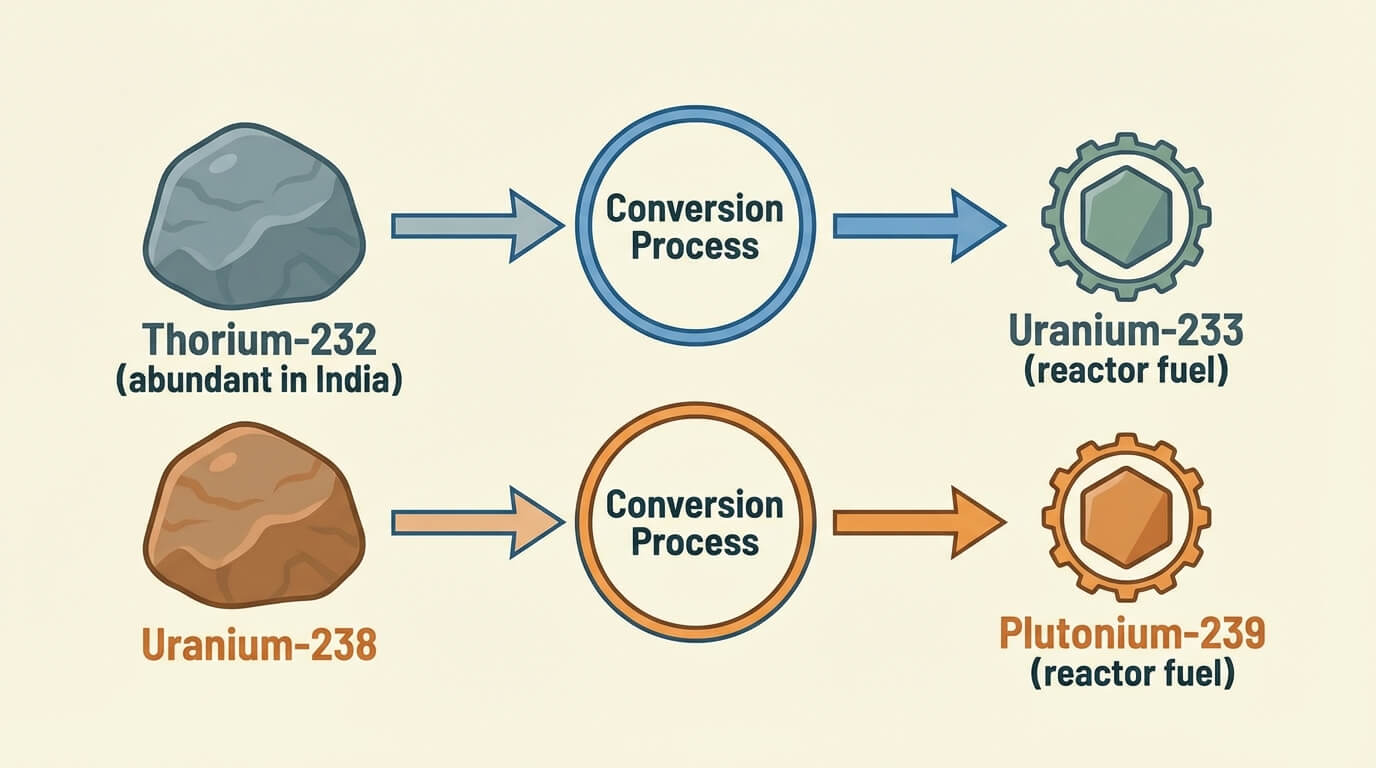
But here's the long game: This reactor is also designed to work with Thorium-232. When thorium is placed in the reactor's "blanket" (the outer layer), fast neutrons convert it into Uranium-233—a new type of fuel.
Status: Just achieved "first criticality" on April 6, 2026. It's alive and running.

Stage 3: Thorium Reactors (The Future)
Once enough Uranium-233 is bred from thorium, India will build reactors that run entirely on thorium-based fuel.
This is the endgame. Thorium is abundant, cleaner, and produces less radioactive waste. With thorium reactors, India could have energy security for hundreds of years.
Status: Still in research and development. But Stage 2 is the crucial bridge to get there.
Why This Reactor Is Different (And Brilliant)
Let me break it down:
✅ Creates more fuel than it consumes - Literally multiplies fuel while running
✅ Uses liquid sodium as coolant - Not water. Sodium can handle much higher temperatures, making the reactor more efficient
✅ Closes the fuel cycle - Recycles nuclear material instead of wasting it
✅ Prepares for thorium - Converts India's massive thorium reserves into usable fuel
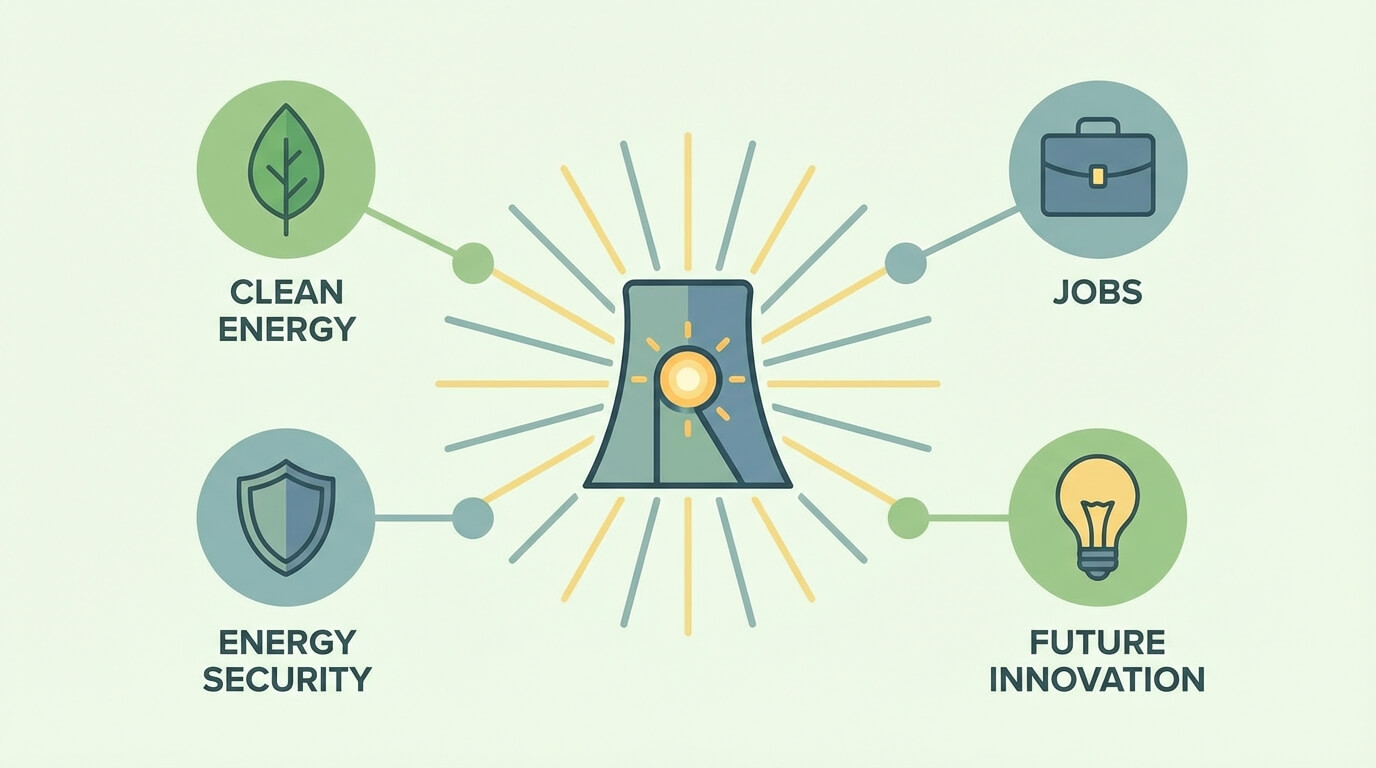
✅ No carbon emissions - Clean, baseload power that runs 24/7 (unlike solar or wind)
✅ Energy independence - Reduces reliance on imported uranium or fossil fuels
✅ Built entirely in India - Designed by IGCAR, built by BHAVINI. 100% indigenous tech. That's Atmanirbhar Bharat in action.
Why This Matters for You (Practical Insights)
For Students: If you're studying science or engineering, this is the future. Nuclear technology, advanced materials, reactor physics—these fields are exploding with opportunities. India is building an entire ecosystem around this.
For India's Energy Future: By 2050, India's electricity demand will skyrocket. EVs, data centers, manufacturing, growing cities—everything needs power. Fast breeder reactors provide clean, reliable, round-the-clock energy without depending on coal or oil imports.
For Jobs and Innovation: Thousands of scientists, engineers, and technicians worked on this project. It's created expertise in cutting-edge fields: liquid metal coolant technology, advanced reactor safety systems, nuclear fuel recycling. This knowledge stays in India.
For the Environment: No coal smoke. No greenhouse gases. Just steady, clean energy. As India aims for net-zero emissions, nuclear power is a critical piece of the puzzle.
The Science Behind It
Let's zoom in on the key concepts without the heavy physics:
What Is Plutonium?
Plutonium is a man-made element. It doesn't exist naturally in large amounts. When Uranium-238 (which is everywhere) absorbs a neutron, it transforms into Plutonium-239.
Plutonium-239 is fissile—it can sustain a chain reaction and release energy. That makes it excellent reactor fuel.
What Is a Fast Breeder Reactor?
"Fast" refers to the speed of neutrons. In regular reactors, neutrons are slowed down (moderated) using water. In a fast breeder reactor, neutrons move at high speed.
Fast neutrons are better at converting fertile materials (like Uranium-238 or Thorium-232) into fissile fuel.
The breeding process:
Core: Burns Plutonium-239 → Produces energy + fast neutrons
Blanket (surrounding layer): Contains Uranium-238 → Absorbs fast neutrons → Becomes Plutonium-239 (new fuel)
Over time, you get more Plutonium-239 out than you put in. Hence, "breeder."
What Is Thorium? (And Why Should Beginners Care?)
Thorium is a naturally occurring element, like uranium. It's a silvery metal found in beach sands and rocks.
Here's what makes it special:
India has one of the world's largest thorium reserves (especially along coastal areas)
Thorium-232 itself can't fuel a reactor directly—it's "fertile," not "fissile"
But when it absorbs a neutron, it converts into Uranium-233, which is fissile and can fuel reactors
Thorium produces less long-lived radioactive waste compared to uranium
It's harder to weaponize, making it safer from a security standpoint
Think of thorium like raw rice: You can't eat it as is, but cook it (convert it in a reactor), and it becomes fuel for energy.
India's long-term plan is to convert its massive thorium reserves into Uranium-233 using fast breeder reactors, then run an entire fleet of thorium-based reactors. That's energy security for centuries.
Chain Reaction Explained (Domino Style)
Imagine dominoes lined up. You tip one, it hits the next, and so on. That's a chain reaction.
In a reactor:
One atom splits → Releases 2-3 neutrons
Each neutron hits another atom → Those atoms split
Each releases more neutrons → Hit more atoms
And on and on
Control rods (made of materials that absorb neutrons) are inserted into the reactor to slow down or stop the reaction. Pull them out a bit, and the reaction speeds up. Push them in, and it slows down. That's how scientists control the power output.
What Does "First Criticality" Mean?
"Criticality" sounds dramatic, but it just means the chain reaction is self-sustaining.
Before criticality: You need an external neutron source to keep things going.
After criticality: The reactor produces enough neutrons on its own to keep the reaction running.
It's like getting a fire started. At first, you need matches and kindling. Once it catches, the fire sustains itself.
On April 6, 2026, India's PFBR reached that point. The reactor is now "alive" and producing energy on its own.

The Road Ahead (What Happens Next)
The reactor achieving criticality is just the beginning. Now comes the gradual power ramp-up—slowly increasing output while monitoring every parameter.
Over the next few months, the PFBR will be tested at different power levels, safety systems will be validated, and eventually, it will reach full capacity: 500 megawatts of electricity.
But the bigger picture? India plans to build more fast breeder reactors. Each one will breed fuel, recycle nuclear materials, and inch closer to the thorium economy.
This is not just about one reactor. It's about proving a technology that could power India for the next 300+ years.
The Bottom Line
India just turned on a reactor that makes its own fuel. Let that sink in.
While the world debates fossil fuels versus renewables, India is quietly building a third path—one that's clean, sustainable, and entirely self-reliant. The 3-stage nuclear program isn't just science. It's a long-term energy strategy designed decades ago by visionaries like Homi Bhabha, and it's finally coming to life.
This is India preparing for a future where energy is abundant, clean, and homegrown.
And honestly? That future just got a whole lot closer.