Homi Bhabha: The Scientist Who Changed India's Future

Picture this. It's the 1940s. World War II just ended. The world is rebuilding. A brilliant young Indian physicist named Homi Bhabha is at Cambridge University, one of the world's greatest institutions. He's doing groundbreaking research. European universities want to keep him. Nobel Prize-level opportunities are within reach.
He could have stayed. Built his career in comfort and prestige in England or America.
Instead, he went home to India.
Not just to India. He went home to build something that didn't exist yet. Something nobody else thought was possible. He walked away from the easiest path to pursue an impossible dream.
Fifty years later, India would have nuclear energy, advanced scientific institutions, and a thriving research community. None of it would have happened without the man who chose to come back when he could have stayed comfortable in the West.
His name was Homi Jehangir Bhabha. And he became the architect of India's scientific future.
Who Was Homi Bhabha?
Homi was born in 1909 into a wealthy Parsi family in Bombay. His father was a lawyer, his mother cultured and well-educated. Unlike many children who play with toys, young Homi played with ideas.
Physics fascinated him. Mathematics excited him. But something else set him apart. He had this ability to see beyond what already existed. To imagine what could be.
At Cambridge, he studied theoretical physics. He wasn't just learning what others had discovered. He was making his own discoveries. His research on cosmic rays and particle physics was gaining international attention. Professors noticed his talent immediately.
Scientists across Europe wanted to work with him. Research positions opened up. Job offers came. The path to becoming a world-famous physicist seemed guaranteed.
But Homi kept thinking about India. About his home country. About what India could become if someone brought modern scientific thinking back.
The Decision That Changed Everything
In 1939, World War II started in Europe. India was still under British rule, but change was coming. The independence movement was building momentum. Intellectuals and leaders were imagining what independent India would look like.
Homi returned to India in 1939. It wasn't a permanent return at first. It was meant to be a temporary visit. But when war broke out across Europe, travel became difficult. His temporary stay became permanent.
And that's when everything changed.
Instead of retreating to a comfortable life in an elite family, Homi decided to do something radical. He would build India's scientific infrastructure from scratch.

Think about what that meant. India in 1940 didn't have advanced research institutions. It didn't have laboratories equipped for cutting-edge physics. It didn't have the scientific culture that Europe had built over centuries.
Starting from nothing. That was Homi's challenge.
Most people would have given up. They'd have thought it was too big, too expensive, too complicated. Homi saw it differently. He saw possibility.
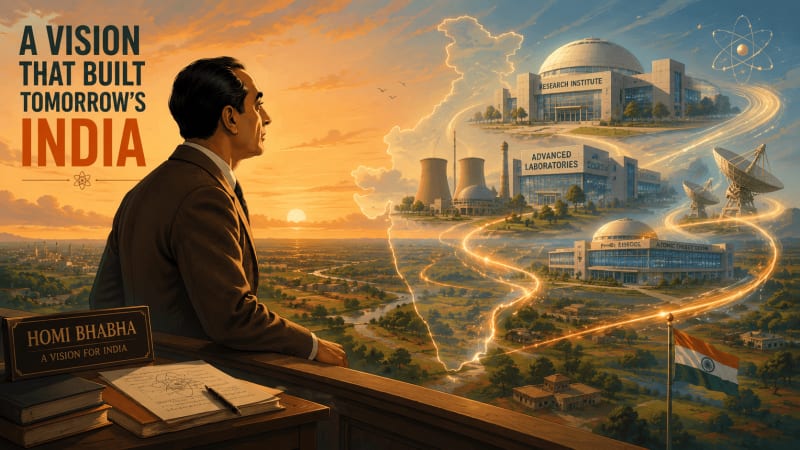
Building the Foundation: TIFR
In 1945, right when India was on the brink of independence, Homi founded the Tata Institute of Fundamental Research in Bombay. TIFR would become Asia's leading research institution.
He didn't do this alone. He got support from the Tata family, one of India's most prominent industrialists. They believed in his vision. They provided resources.
But the real work was Homi's vision and energy. He designed the institute to be a place where brilliant minds could pursue fundamental science without worrying about immediate practical applications. Pure research. Curiosity-driven science.
The building opened, and brilliant scientists started arriving. Within years, TIFR became known across the world. Young Indian scientists who might have left for Europe or America now had somewhere to stay, to work, to contribute.
TIFR became proof of concept. Proof that India could do world-class science.
India's Nuclear Journey Begins
While TIFR was being built, something bigger was happening. India's leaders were thinking about the future. They knew nuclear energy would matter. The world was entering the nuclear age.
They turned to Homi.
In 1948, the Indian government established the Atomic Energy Commission. Homi Bhabha was chosen to lead it. He became the chairman of India's atomic energy program at a time when most countries already had nuclear programs running.
India was starting late. But Homi had a plan.
He didn't just want nuclear weapons. That wasn't his focus. He wanted nuclear energy for India's development. Power generation. Medical applications. Industrial use. He believed nuclear technology would help lift India out of poverty and into the modern world.
This required building everything. Reactors. Research facilities. Training scientists. Creating institutions. Developing expertise from scratch.
By 1954, India's first nuclear reactor, called APSARA, went critical. It was a massive achievement. India became only the sixth country in the world to have a nuclear reactor.
This wasn't copying Western technology. This was building it ourselves. Indian scientists and engineers, working under Homi's leadership, developed the capability themselves.
The Visionary Who Thought Long-Term
What made Homi different from other scientists was his thinking about the long term.
He created a three-stage nuclear power program for India. First stage: use natural uranium and heavy water reactors. Second stage: develop fast breeder reactors to create more fuel. Third stage: eventually use thorium, which India had in abundance.
This wasn't thinking about next year or even next decade. This was thinking 50 years into the future. Creating a sustainable path for India's nuclear development.
Most people plan five years ahead. Homi was planning for decades. He believed that if India could master nuclear science and technology, it would gain energy security and technological capability that would help it develop as a modern nation.
He was right. That three-stage program still guides India's nuclear energy development today.
The Tragedy
On January 24, 1966, Homi boarded an Air India flight from Montreal to London. He was 56 years old. He was attending scientific conferences and discussing India's nuclear program with international scientists.
The plane crashed near Mont Blanc in the Alps. All 117 people aboard died. Homi was among them.
The news shocked India. Scientists across the world mourned. A brilliant mind, a visionary leader, was suddenly gone.
India had lost the man who shaped its scientific future.
What makes this even more tragic is that Homi had so much more to accomplish. His vision for India's scientific development was far from complete. The institutions he built were still young. The nuclear program was still developing.
But he had laid the foundation. He had shown India that it was possible. That's what mattered.
What Homi Bhabha Left Behind
Today, more than 50 years after his death, India's nuclear program continues. The Bhabha Atomic Research Centre, named after him, remains India's premier nuclear research institution.
TIFR produced some of India's greatest scientists. Many who studied or worked there went on to lead scientific efforts across the country. The culture of research that Homi established continues.
India developed nuclear energy. India became a nuclear power. India created a scientific ecosystem that produces world-class research.
Did all this happen because of Homi alone? No. Thousands of scientists contributed. Governments supported. Industries built.
But it started with one man's vision. One man who believed that India could be a scientific nation. Who came back when he could have stayed comfortable abroad. Who built institutions that outlived him by decades.
That's legacy.
When you see Indian scientists winning international awards. When you see Indian space missions succeeding. When you see Indian research institutions recognized globally. When you see India developing nuclear energy independently. None of that would have happened without the foundation Homi Bhabha built.
The Enduring Impact
More than 50 years have passed since Homi Bhabha's death. Yet the institutions he created continue shaping India's scientific future.
TIFR remains one of the world's top research institutions. BARC leads India's nuclear program. Thousands of scientists trained in the culture Homi established are advancing research across the country.
When you use electricity from a nuclear power plant in India, you're benefiting from his vision. When young Indian scientists conduct groundbreaking research, they're standing on foundations he built.
That's what true leadership looks like. Not just achieving things during your lifetime. But creating systems and institutions that continue serving humanity long after you're gone.
Homi Bhabha chose to come home when he could have stayed comfortable abroad. He believed in India's potential when many doubted it. He built institutions that outlived him by decades.
That one decision, made in the 1940s, changed the trajectory of an entire nation.
FAQs
• Who was Homi Bhabha?
Homi Jehangir Bhabha (1909–1966) was an Indian physicist and visionary scientist who founded the Tata Institute of Fundamental Research (TIFR) and led India's atomic energy program. He is widely regarded as the architect of India's scientific and nuclear development.
• Why is he called the Father of India's Nuclear Program?
Homi Bhabha established India's Atomic Energy Commission and designed the foundation of India's nuclear power program. His vision and leadership helped India build its early nuclear infrastructure and laid the groundwork for future nuclear research and energy production.
• What did Homi Bhabha discover scientifically?
Bhabha made important contributions to theoretical physics, especially in cosmic rays and particle physics. He is best known for "Bhabha Scattering," but his greatest achievement was creating scientific institutions that transformed India's research ecosystem.
• How did Homi Bhabha die?
Homi Bhabha died on January 24, 1966, in the Air India Flight 101 crash near Mont Blanc in the French Alps. He was 56 years old and was traveling from Montreal to London when the accident occurred.
• What is the Bhabha Atomic Research Centre (BARC)?
BARC is India's premier nuclear research facility. Named in honor of Homi Bhabha, it conducts advanced research in nuclear science, atomic energy, reactor technology, and related fields.
• What is TIFR and why is it important?
The Tata Institute of Fundamental Research (TIFR), founded by Homi Bhabha in 1945, became one of Asia's leading scientific research institutions. It played a key role in developing world-class scientific talent and advancing research in India.
• What is Homi Bhabha's legacy today?
Homi Bhabha's legacy lives on through institutions like TIFR and BARC. His vision helped build the foundation of modern scientific research, nuclear technology, and technological self-reliance in India.