Sushruta: The World's First Surgeon and the Advanced Science of Ancient India

The Surgeon Who Operated 2,500 Years Before Modern Medicine
Imagine lying on a treatment table in 600 BCE. No anesthesia machines. No sterile operating rooms. No antibiotics. Yet, the physician standing over you is about to reconstruct your nose using a flap of skin from your forehead.
Sounds impossible? It happened.
His name was Sushruta. And while the rest of the world was still figuring out basic medicine, he was performing complex surgeries, training students in surgical techniques, and documenting over 300 procedures in a medical text that would influence healing traditions for millennia.
Ancient India wasn't just spiritually advanced—it was a powerhouse of medical science. And Sushruta? He was its brightest surgical mind.

Who Was Sushruta?
Sushruta lived around 600 BCE in ancient India, likely in the region near Varanasi (modern-day Uttar Pradesh). Some texts place him even earlier, around 800 BCE.
He's known as the "Father of Surgery" (Shalya Tantra in Sanskrit). Not just in India—globally. Centuries before Hippocrates became famous in Greece, Sushruta was already teaching anatomy, dissection, and surgical intervention.
But he wasn't working alone. Sushruta was part of a broader medical tradition rooted in Ayurveda—India's ancient system of holistic medicine. He learned from his teacher, the legendary physician Dhanvantari (considered the god of Ayurveda in Hindu tradition).
What set Sushruta apart? He didn't just theorize. He practiced. He taught. He documented everything.

What Is the Sushruta Samhita?
The Sushruta Samhita is one of the oldest and most comprehensive surgical texts in human history. Written in Sanskrit, it's a foundational text of Ayurveda.
Think of it as the world's first surgical manual.
The text is organized into six sections (Sthanas):
Sutrasthana – General principles, diet, lifestyle
Nidanasthana – Diagnosis and pathology
Sharirasthana – Anatomy and embryology
Chikitsasthana – Treatment methods
Kalpasthana – Toxicology
Uttaratantra – Specialized treatments (eyes, ears, pediatrics)
It describes:
Over 300 surgical procedures
120+ surgical instruments (scalpels, forceps, needles, saws)
Detailed anatomy of the human body
Pre-operative and post-operative care
Anesthesia techniques
Wound healing methods
And here's the kicker: This was all documented more than 2,500 years ago.
Surgical Techniques That Were Centuries Ahead
Rhinoplasty (Nose Reconstruction)
This is Sushruta's most famous contribution.
In ancient India, cutting off someone's nose was a common punishment for crimes (especially adultery). Brutal, yes. But Sushruta saw an opportunity to restore dignity.
He developed rhinoplasty—reconstructive nose surgery—using what's now called the "forehead flap technique."
Here's how it worked:

Measure the damaged nose area.
Cut a flap of skin from the forehead (keeping one end attached for blood supply).
Twist the flap down to cover the nose.
Stitch it in place.
Insert reed tubes into the nostrils to maintain airway and shape.
Apply healing pastes (turmeric, honey, ghee).
Allow healing over weeks with regular dressing changes.
This technique is still used in modern plastic surgery with minor modifications. Surgeons today call it the "Indian flap method."
Cataract Surgery (Couching)
Sushruta also performed cataract removal. The technique, called "couching," involved using a curved needle to push the clouded lens to the bottom of the eye, restoring partial vision.
Was it perfect? No. Modern cataract surgery is far superior. But for 600 BCE? Revolutionary.
Other Procedures Sushruta Described:
Lithotomy (bladder stone removal)
Cesarean section (emergency childbirth)
Hernia repair
Fistula treatment
Plastic surgery (earlobe reconstruction, skin grafts)
Wound suturing using natural fibers, even ant mandibles as clamps
120+ Surgical Instruments
Sushruta classified surgical tools into two types:
Yantras (blunt instruments) – forceps, speculums, tubes
Shastras (sharp instruments) – scalpels, lancets, saws, needles
He described their design, material (often made of metal or wood), and specific uses. Many resemble tools still used in surgery today.

How Advanced Was Ancient Indian Medical Training?
Sushruta didn't just perform surgeries—he built a systematic training program for students.
Hands-On Practice (No Direct Human Practice)
Students couldn't just jump into surgery. They trained progressively:
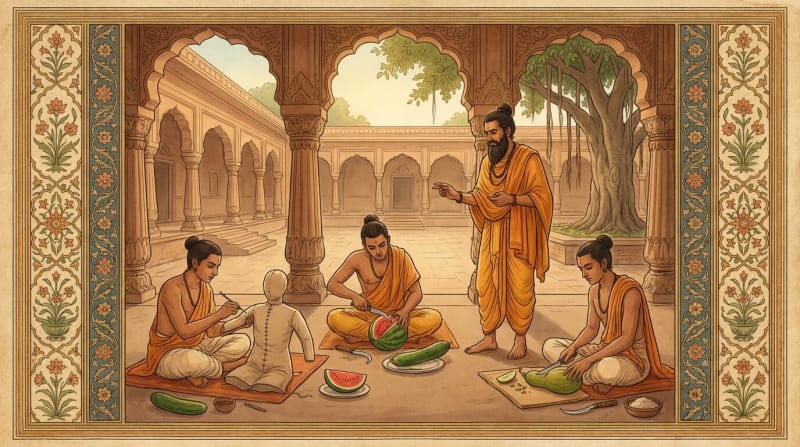
Incision practice: Cutting watermelons, cucumbers, and soft fruits to master blade control.
Suturing practice: Stitching leather, cloth, and animal hide.
Vein/tube practice: Working with lotus stems and hollow reeds.
Extraction practice: Removing seeds from fruits to simulate foreign object removal.
Bandaging: Practicing on dolls and mannequins.
Only after months of training were students allowed near actual patients.
Early Anesthesia
Sushruta understood pain management. He used:
Alcohol (wine-based sedatives)
Cannabis extracts
Henbane and other herbs with sedative properties
Patients were given these before surgery to dull pain and induce drowsiness. Not as effective as modern anesthesia, but far ahead of most ancient civilizations.
Hygiene and Sterilization
Sushruta emphasized cleanliness:
Instruments were cleaned and sometimes heated.
Surgical areas were kept clean.
Surgeons washed hands before procedures.
Post-operative wounds were dressed with antiseptic pastes (honey, turmeric, neem).
This was centuries before germ theory. Yet, Sushruta intuitively understood that cleanliness prevented infection.
How Sushruta's Knowledge Spread Beyond India
Ancient India wasn't isolated. It was a hub of trade, knowledge exchange, and cultural interaction.
Routes of knowledge transfer:
Buddhist monks carried medical texts along the Silk Road to China, Tibet, and Southeast Asia.
Arab scholars translated Sanskrit medical texts (including Sushruta Samhita) into Arabic during the Islamic Golden Age (8th–13th century).
Persian and Greek physicians encountered Indian medical knowledge through trade and conquest (Alexander the Great's campaigns brought Indian physicians into contact with Greek medicine).
Impact on later medical systems:
Islamic medicine (Unani): Integrated Ayurvedic surgical techniques.
Medieval European surgery: Rhinoplasty techniques were reintroduced to Europe in the 16th century by Italian surgeon Gaspare Tagliacozzi, who learned them from Arabic sources—which traced back to Sushruta.
The forehead flap rhinoplasty described by Sushruta reached Britain in the 1790s, where British surgeons witnessed it in India and brought it back to London medical journals.
Reality Check: Let's Be Honest About Limitations
Sushruta was brilliant. Ancient Indian medicine was advanced. But let's not romanticize beyond reality.
What ancient surgery lacked:
No germ theory: They didn't know about bacteria. Hygiene practices were based on observation, not scientific understanding of microbes.
High infection rates: Even with antiseptic pastes, many patients likely died from post-surgical infections.
Crude anesthesia: Pain management was limited. Procedures were still agonizing.
No antibiotics: Infections that modern antibiotics cure easily were often fatal.
Limited understanding of internal anatomy: Dissection was practiced (on cadavers), but knowledge of internal organs and systems was incomplete.

But here's what matters: Sushruta worked with the tools and knowledge available in his time. And within those constraints, he pushed boundaries further than almost anyone else in the ancient world.
Why Sushruta Still Matters Today
Every time a plastic surgeon reconstructs a nose, they're using principles Sushruta documented 2,500 years ago.
Every time a medical student learns surgical anatomy, they're walking a path Sushruta helped pave.
His contributions to modern medicine:
Rhinoplasty techniques are still taught in medical schools.
Surgical training methods (practice on models before humans) remain foundational.
Emphasis on hygiene foreshadowed germ theory by centuries.
Classification of surgical instruments influenced how we organize medical tools today.
Beyond technique, Sushruta established principles:
Surgery as a legitimate branch of medicine (not just a last resort).
Systematic documentation of procedures.
Ethical considerations (patient care, minimizing harm).
In 2003, the British Association of Plastic Surgeons acknowledged Sushruta's pioneering work, stating that he "deserves recognition as the world's first plastic surgeon."
FAQs About Sushruta and Ancient Indian Surgery
Who was Sushruta?
Sushruta was an ancient Indian physician who lived around 600 BCE. He's known as the "Father of Surgery" for developing surgical techniques and documenting over 300 procedures in the text Sushruta Samhita.
Why is Sushruta called the first surgeon?
Sushruta is considered the first surgeon because he systematically documented surgical procedures, designed specialized instruments, and developed training methods for surgery—centuries before similar practices emerged elsewhere.
What is the Sushruta Samhita?
The Sushruta Samhita is an ancient Sanskrit medical text written by Sushruta. It covers surgery, anatomy, diagnosis, treatment, and describes 300+ surgical procedures and 120+ surgical instruments.
Did ancient India really have advanced surgery?
Yes. Ancient India had sophisticated surgical practices including rhinoplasty (nose reconstruction), cataract surgery, wound suturing, and more. Sushruta's techniques, especially the forehead flap rhinoplasty, are still used in modified forms today.
How did Sushruta perform surgeries without modern tools?
Sushruta used metal instruments (scalpels, forceps, needles), herbal anesthesia (alcohol, cannabis), antiseptic pastes (honey, turmeric), and careful surgical techniques. While not as advanced as modern surgery, his methods were remarkably effective for his time.
The Legacy That Endures
A surgeon in 600 BCE cutting into human flesh without germ theory. Without antibiotics. Without modern anesthesia.
And yet, creating techniques that would travel through centuries, across continents, and into modern operating rooms.
That's Sushruta's story.
He didn't have the luxury of scientific labs or peer-reviewed journals. He had observation, intuition, rigorous training, and a commitment to healing. He saw suffering and innovated solutions. He taught students who taught others, creating ripples that never stopped.
Ancient India wasn't just a land of philosophy and spirituality. It was a civilization where science thrived, where knowledge was systematically organized, where innovation happened not in spite of tradition but through it.
Sushruta proved that medicine isn't just about technology—it's about understanding the human body, respecting the patient, and constantly pushing the boundaries of what's possible.
His hands shaped noses 2,500 years ago. His ideas still shape surgery today.
That's not just history. That's immortality.