The Day a Student's Life Changed Forever
Meet Priya. She's a 14-year-old in Bhubaneswar who struggled with algebra for two years straight. Her teachers were great — but with 45 students in one classroom, there was no way anyone could sit with Priya every single day and explain fractions in the exact way her brain understood them.

Then, her school introduced an AI-powered learning tool.
Within three weeks, Priya's test scores jumped by 22%. Not because the tool was magic — but because, for the first time, someone (or something) was actually paying attention to how she learned, not just what she should learn.

That's the real story of how AI is changing education in 2026. It's not about robots replacing teachers. It's about every student — finally — getting the attention they deserve.
So, What's Actually Going On? (The Simple Version)
AI in education is like having a personal tutor, a patient librarian, and a sharp guidance counselor — all rolled into one app.

These systems watch how students learn, spot where they're struggling, and adjust the content in real time. And in 2026, this isn't experimental anymore. It's happening in classrooms across India, the US, Africa, and Southeast Asia — right now.
How AI in Education Actually Works — Step by Step
Step 1: AI Watches How You Learn (Not Just What You Score)
Traditional education measures you at the end — through exams. AI flips this. It watches your process.
Did you skip a paragraph and come back? Did you get question 4 wrong three times in a row? Did you spend 40 seconds on a concept you should have nailed in 10?

AI systems like Khan Academy's Khanmigo or Synthesis track these micro-behaviours constantly. Think of it like a Fitbit — but for your brain. It's always collecting data in the background so it can make smarter decisions for you later.
Real-life example: A student in Lagos studying for his chemistry board exam gets stuck on covalent bonds. The AI notices he's re-reading the same paragraph five times. Instead of moving on, it serves him a short animated video explanation. That's not a teacher decision — it happened automatically, in seconds.
Step 2: AI Builds a Learning Path Just for You
Once the system knows your weak spots, it doesn't just pile on more practice problems. It sequences the learning — almost like a GPS rerouting when you take a wrong turn.
Think of it this way: if you're driving from Delhi to Jaipur and you miss an exit, Google Maps doesn't say "you failed, go back to Delhi." It just recalculates.

AI tutors do the same thing. Miss a concept? The system backs up, reinforces it, then re-approaches the original goal from a different angle.
Tools doing this in 2026: Coursera's AI Coach, BYJU's adaptive engine, and DreamBox for math (popular in primary schools globally).

Step 3: Real-Time Feedback — No More Waiting Until Tuesday
One of the biggest frustrations in traditional learning? Submitting an assignment on Friday and not knowing if you were right until the next week.
AI closes this loop instantly.
Picture this: a student submits an essay on climate change. Within 30 seconds, the AI gives structured feedback — not just "good job" or "needs improvement" — but specific notes like:

"You make a compelling point in the second paragraph; adding a supporting statistic would make it even stronger."
"Paragraph 4 repeats the same idea as paragraph 1 — try connecting them instead."
This kind of feedback was once only possible with a dedicated writing tutor. In 2026, it's available to anyone with a phone.
Step 4: AI Assists Teachers — It Doesn't Replace Them
Many individuals make an error at this stage. AI isn't kicking teachers out of classrooms. It's handing them a superpower.
In 2026, a teacher's biggest time-drain is administrative: grading papers, marking attendance, creating assessments, writing progress reports. AI handles most of this in the background.

That frees the teacher to do what AI cannot — build genuine human relationships, mentor struggling students emotionally, inspire curiosity, and handle the messy, beautiful unpredictability of real human beings in a room together.
Real example: A school in Finland now uses an AI system that auto-generates weekly progress summaries for every student. Teachers review them in minutes instead of hours — and spend the saved time in 1-on-1 conversations with students who need it most.
Step 5: AI Makes Education Accessible at Scale
Make no mistake: this is the most essential part of the process.
In 2026, a student in a rural village in Odisha and a student in central London can access the same quality of personalised education — as long as they have a phone and an internet connection.
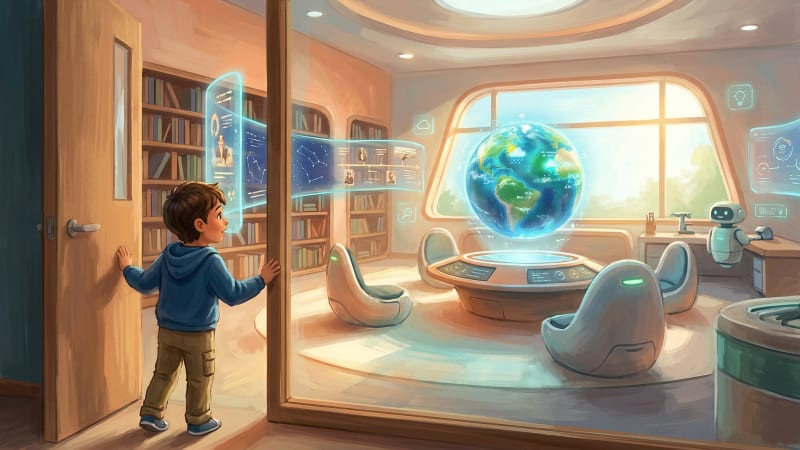
AI-powered tools now support 50+ languages, adapt content for students with dyslexia or ADHD, and can function on low-bandwidth connections. The quality gap between "well-funded schools" and "everyone else" is quietly, steadily closing.
A Complete Real-Life Scenario: Arjun's Story
Arjun is a Class 10 student in a semi-urban school in Madhya Pradesh. His school recently adopted an AI learning platform.
Here's what a normal Tuesday looks like for him now:
Morning: He logs in and the platform gives him a 10-minute warm-up quiz based on yesterday's session. It already knows he got three questions wrong on photosynthesis — so the quiz focuses there.
During class: His teacher explains the chapter on ecosystems. The AI tool is running silently in the background, noting which students look disengaged (via attention-tracking) and which concepts the teacher spent the most time on.
After school: Arjun opens the app and gets a personalised practice set — not generic textbook questions, but his gaps addressed in his order of priority.
Weekend: His parents get a simple report card: "Arjun is performing well in biology but needs reinforcement in chemical equations. Here are 3 short videos we recommend."
No tuition centre. No extra fees. Just smarter, personalised learning — available everywhere.
Why This System Works So Well
Personalisation at scale — one AI can serve 10,000 students simultaneously, each with a different learning path
Speed — feedback loops that used to take days now happen in seconds
Consistency — an AI never has a bad day, never loses patience, and never forgets where a student left off
Data-driven decisions — instead of gut feel, teachers and parents get real evidence of what's working
Inclusivity — students with learning differences, language barriers, or geographic limitations finally get tools built for them
Actionable Tips: How You Can Use AI in Education Right Now
Whether you're a student, teacher, or parent — here's what you can actually do today:
For Students:
Try Khan Academy's Khanmigo for personalised tutoring across subjects — it's free and surprisingly good
Use Notion AI or ChatGPT to explain tough concepts in simpler language (ask it: "Explain quantum physics like I'm 12")
Don't just consume AI answers — always ask why something is correct so you actually learn it
For Teachers:
Use Google's NotebookLM to summarise textbooks and generate discussion questions instantly
Try MagicSchool AI — it's built specifically for educators and can auto-generate lesson plans, rubrics, and parent emails
Use AI to identify your 5 most-struggling students each week and invest your face-time there
For Parents:
Ask your child's school what AI tools they're using — and ask for the student reports
Let your child explore AI tools with you — treat it as a conversation, not a threat
Focus on learning quality, not just screen time. 20 minutes of adaptive AI practice can beat 2 hours of passive YouTube
Developer Insight: What's Powering All of This?
If you're curious about the tech underneath — here's the beginner-friendly version:
Most AI education tools are built on Large Language Models (LLMs) — the same kind of technology behind ChatGPT — combined with Reinforcement Learning from Human Feedback (RLHF), which helps the system get better the more students use it.
The personalisation layer uses something called a Knowledge Graph — essentially a map of all the concepts in a subject and how they connect. When you get a question wrong, the system traces it back through the graph to find the root concept you may have missed.
Add in Natural Language Processing (NLP) for essay grading, computer vision for attention tracking in some systems, and cloud infrastructure for scale — and you have the backbone of modern AI education tools.
You don't need to understand all of this to benefit from it. But knowing it exists makes it less mysterious — and a lot more exciting.
Conclusion
How AI is changing education in 2026 isn't a future story — it's happening right now, in classrooms and on phone screens around the world.
The students who thrive won't just be the ones who use AI tools — they'll be the ones who learn with them, stay curious, and never stop asking why.
The classroom of the future isn't somewhere else. It's already here. Step in.