Narinder Singh Kapany: The Father of Fiber Optics Who Connected the World

Right now, as you read this article, data is traveling through your internet connection at the speed of light. Every video you watch, every message you send, every call you make—it's all riding on waves of light traveling through microscopic glass fibers.
This entire digital world exists because of one Indian scientist.
His name is Narinder Singh Kapany.
You might not know him. Your school history book probably doesn't mention him. Tech documentaries focus on Steve Jobs, Bill Gates, and Elon Musk. But the infrastructure that made all their innovations possible? That came from Kapany.
Think about it this way: Without Kapany's breakthrough, the internet as we know it wouldn't exist. No YouTube. No Netflix. No video calls. No cloud storage. No online everything.
Every time you open your phone and data flows instantly to your fingertips, you're experiencing the result of his genius.
And yet, most people have never heard his name.
This is his story—a story of curiosity, brilliance, and a discovery so profound that it reshaped human communication itself.
Who Was Narinder Singh Kapany?
The Boy Who Wondered About Light
Narinder Singh Kapany was born on October 10, 1926, in Moga, Punjab—a small town in northern India.
His childhood was ordinary in many ways. Like most Indian children of that era, he grew up in a traditional Sikh household, played outdoors, and attended school with thousands of other students.
But something set him apart: he was obsessed with light.
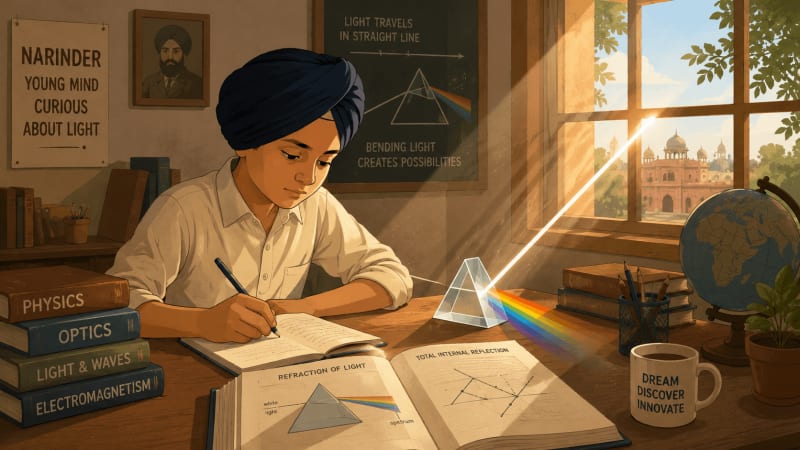
While other children played cricket or chased each other around gardens, young Narinder stared at sunrays filtering through windows. He wondered how light worked. Why was it fast? Could it be controlled? Could it be bent?
These weren't casual questions. This was the curiosity of a mind that would later reshape technology.
His teachers noticed. They recognized something special in this boy who asked deeper questions than the curriculum demanded.
Education: From Punjab to the World
Kapany's educational journey is itself a fascinating arc.
He completed his early schooling in Punjab. But Punjab alone couldn't contain his ambitions. He wanted to learn from the best institutions in the world.
In the late 1940s and early 1950s, this was a massive undertaking for an Indian student. The world was still emerging from post-war chaos. Travel was difficult. International education was a luxury few could afford.
But Kapany had determination.
He pursued his bachelor's degree in physics and then decided to study further. The path led him to India's premier science institutions, where his talent became undeniable.
Then came the leap: He moved to London.
In 1952, Kapany joined Imperial College London for his doctorate in physics. Imperial College wasn't just any university—it was one of the world's leading institutions for scientific research. Here, surrounded by brilliant minds and cutting-edge laboratories, Kapany would make his world-changing discovery.
But he didn't arrive with a clear plan for fiber optics. That came later.

The Discovery: When Kapany Bent Light
The Problem Everyone Ignored
In the 1950s, communication was limited.
Long-distance phone calls required enormous copper wire networks. Radio transmission had limits. Signals degraded over distance. If you wanted to send data or information across the globe, it was slow, expensive, and unreliable.
Scientists around the world were searching for a solution. Could light be used to transmit information? Light traveled faster than anything known to humanity—it was the ultimate messenger.
But there was a massive problem: light travels in straight lines.
If you tried to transmit light through a regular glass rod, the light would scatter, bend away at angles, and dissipate. You couldn't guide light around corners or through tangled routes. It would just spread out and disappear.
Scientists thought this was impossible to overcome.
Most researchers accepted this as a fundamental law of physics. You couldn't force light to stay within a narrow path. That was just how light behaved.
Narinder Singh Kapany didn't accept it.
The Eureka Moment
Here's where the story gets interesting.
Kapany was researching optical science at Imperial College. He was reading papers, studying light behavior, running experiments. His curiosity didn't focus on communications yet—that came later. He was simply asking: What if we could confine light and make it travel through a thin glass fiber?
It sounds simple now. But in the 1950s, it was radical.
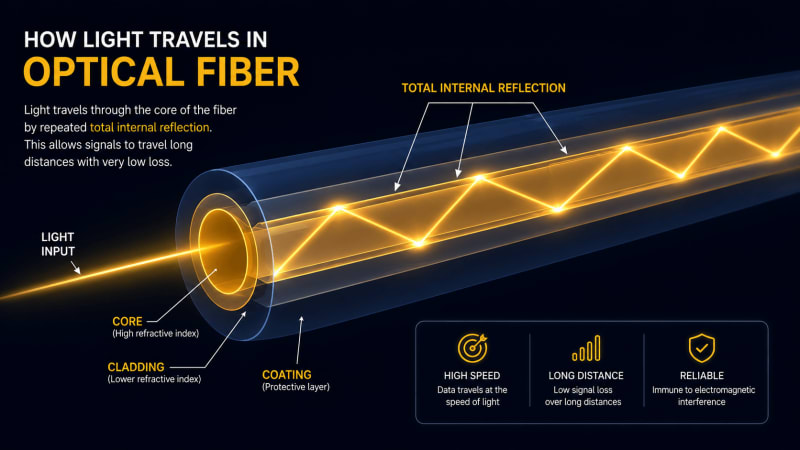
The key insight: If you make the glass fiber thin enough and bend it carefully, light could be trapped inside through a principle called total internal reflection.
Think of it like a water pipe. Water doesn't escape the sides of the pipe—it stays contained and travels to where you want it. Kapany realized light could work the same way if the physics was right.
In 1955–1956, Kapany conducted the breakthrough experiment.
He created a bundle of thin glass fibers and sent light through them. The light bounced internally within the fiber, traveling from one end to the other—even when the fiber was bent.
The light stayed trapped inside the glass.
For the first time in human history, light had been successfully guided through a flexible path. It could be bent, twisted, and directed without escaping.
Kapany had proved the impossible.
He published his findings in 1960 in a groundbreaking paper, officially introducing the concept of "fiber optics" to the scientific world.
The response? Skepticism. Dismissal. "Interesting academic work, but no practical applications."
Kapany knew better. He understood the implications immediately.
Why This Discovery Changed Everything
Understanding Fiber Optics (Simple Version)
Before we go further, let's break down what fiber optics actually is, in terms anyone can understand.
Traditional copper wire:
Electricity travels through metal
Electrons move, carrying electrical signals
Limited by resistance and heat
Can carry limited data
Fiber optic cable:
Light (photons) travels through glass
Light carries information as pulses
Travels at the speed of light
Can carry vastly more data simultaneously
No electromagnetic interference
Works over longer distances without signal loss
The magic: Light doesn't degrade the way electrical signals do. You can send pulses of light—representing 1s and 0s (binary code)—through a thin glass fiber for hundreds of kilometers with minimal signal loss.
One fiber optic strand (thinner than a human hair) can transmit terabits of data per second.
Compare that to copper wires, which struggle to match even a fraction of that capacity.
That's why fiber optics became the backbone of modern telecommunications.
The Domino Effect
Once Kapany proved fiber optics worked, the implications exploded:
1960s–1970s: Researchers and companies began serious development of practical fiber optics.
1977: First commercial fiber optic telecommunications system went live in Chicago.
1980s: Fiber optics started replacing copper networks globally.
1990s: The internet boom rode on fiber optic infrastructure.
2000s onwards: Fiber optics became the foundation of modern global communication.
Without Kapany's breakthrough, telecommunications would have remained limited. The internet revolution might have happened much slower—or not at all.
Every major internet infrastructure project depends on fiber optics:
Undersea cables connecting continents
Backbone networks within countries
Data centers linked globally
5G networks (use fiber between towers)
The Internet You Use Every Day Runs on Fiber Optics
Let's make this concrete. That video call with family? Fiber optics. YouTube streaming 1 billion hours of video daily? Fiber optics. Your photos backing up to Google Photos? Stored in data centers connected by fiber optics. Stock market trades happening in microseconds? Fiber optics.
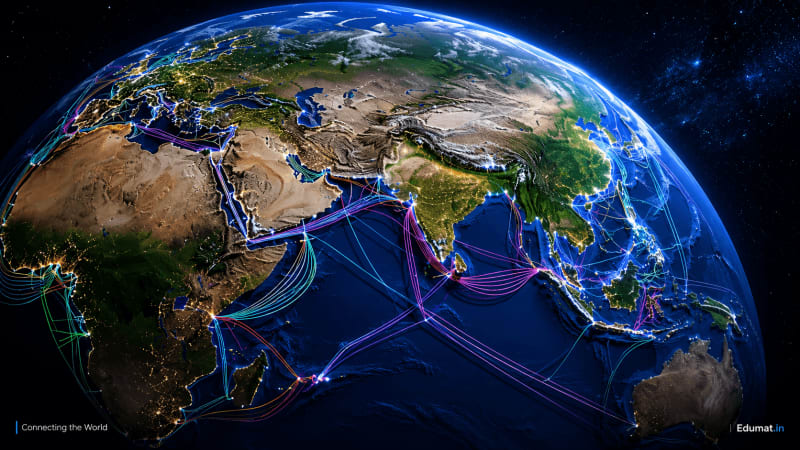
Most people don't realize: the global internet isn't wireless. It doesn't fly through the air between continents. It travels through cables on the ocean floor—and those cables are made of fiber optics.
Right now, over 400 submarine fiber optic cables sit on the ocean floor, connecting every continent and carrying 99% of all international internet traffic. When you video call someone in another country, that signal travels underwater through infrastructure built entirely on Kapany's breakthrough.
Beyond the Internet: Medicine Changed Too
Fiber optics didn't just transform communications—it revolutionized medicine. Fiber optic endoscopes use bundles of optical fibers to transmit images from inside the human body, enabling doctors to examine internal organs without large surgical incisions.
Before fiber optics, surgery often required opening the body just to see what was inside. After fiber optics, doctors could insert thin, flexible scopes and visualize organs with total clarity. Today, fiber optic technology is standard in gastroenterology, orthopedic surgery, cardiac procedures, and cancer detection. Millions of people have benefited from procedures made possible by Kapany's technology.
The Legacy
Kapany received the Padma Vibhushan in 2010—India's second-highest civilian honor—specifically for his contributions to fiber optics and telecommunications. He filed over 100 patents related to optical systems throughout his career. He also became an entrepreneur, starting companies to commercialize fiber optics because he understood that great science means nothing if it stays locked in laboratories.
Yet despite all this, he never became a household name. Fiber optics is infrastructure—invisible, behind the scenes, absolutely essential. We celebrate the CEOs who build products, but rarely the scientists whose discoveries make those products possible.
Narinder Singh Kapany passed away in 2020 at the age of 94.
His greatest legacy isn't measured in awards or patents. It's measured in the billions of people connected through fiber optics every single day—every data packet traveling through glass, every video call, every internet connection, every moment of real-time global communication.
He bent light. And in doing so, bent the arc of human communication toward connection forever.
That's not small. That's everything.
FAQs About Narinder Singh Kapany and Fiber Optics
1. Who is Narinder Singh Kapany? He's an Indian-born scientist known as the "Father of Fiber Optics." His 1950s discovery that light could be guided through thin glass fibers became the foundation of modern telecommunications and the internet.
2. How did Kapany discover fiber optics? At Imperial College London, he proved that making glass fibers thin enough causes light to stay trapped inside through total internal reflection. He published his findings in 1960, introducing fiber optics to the world.
3. What is total internal reflection? It's when light hits the inner wall of a glass fiber at a steep angle and bounces back inward instead of escaping—keeping light confined as it travels through the fiber.
4. Why are fiber optics important for the internet? A single fiber transmits terabits of data per second at the speed of light over long distances with minimal signal loss—far beyond what copper wires can handle. Without it, the global internet wouldn't exist.
5. How does fiber optic technology work? Light pulses travel through a thin glass fiber, bouncing internally from wall to wall. These pulses represent 1s and 0s (binary data), which are converted back to electrical signals at the receiving end.
6. What did Kapany contribute to medicine? He pioneered fiber optic endoscopes—thin, flexible tubes that let doctors see inside the body without large incisions. This transformed minimally invasive surgery and diagnostic imaging worldwide.
7. Why isn't Kapany as famous as Jobs or Gates? Fiber optics is invisible infrastructure, not a consumer product. Recognition often follows marketing over actual impact. Within science and engineering communities, however, Kapany is widely respected.
8. How many patents did Kapany file? Over 100 patents covering fiber optic transmission, optical fiber design, medical endoscopes, optical sensors, and photonic systems.
9. Can fiber optic cables break? Yes—from ship anchors, earthquakes, fishing activity, or even shark bites. Repair ships locate and splice breaks. Redundant network paths ensure a single break doesn't disrupt service.
10. Is fiber optics still the future? It's already the present backbone of global internet. The future includes more homes getting direct fiber connections, quantum communication over fiber, and new photonic technologies—all building on Kapany's original breakthrough.